
From $119 · About an hour · No call-out fee
Garage Door Roller Replacement in Golden Gate, FL
Garage door roller replacement in Golden Gate is the least glamorous job we do and the one with the best return. Ten nylon rollers, fitted and the door re-balanced, from $119 — and a door that was grinding, shuddering and waking the house goes quiet the same afternoon. It is also the repair that prevents the expensive ones, because a collapsed roller is how doors come off their tracks.
What rollers actually do, and why they go first
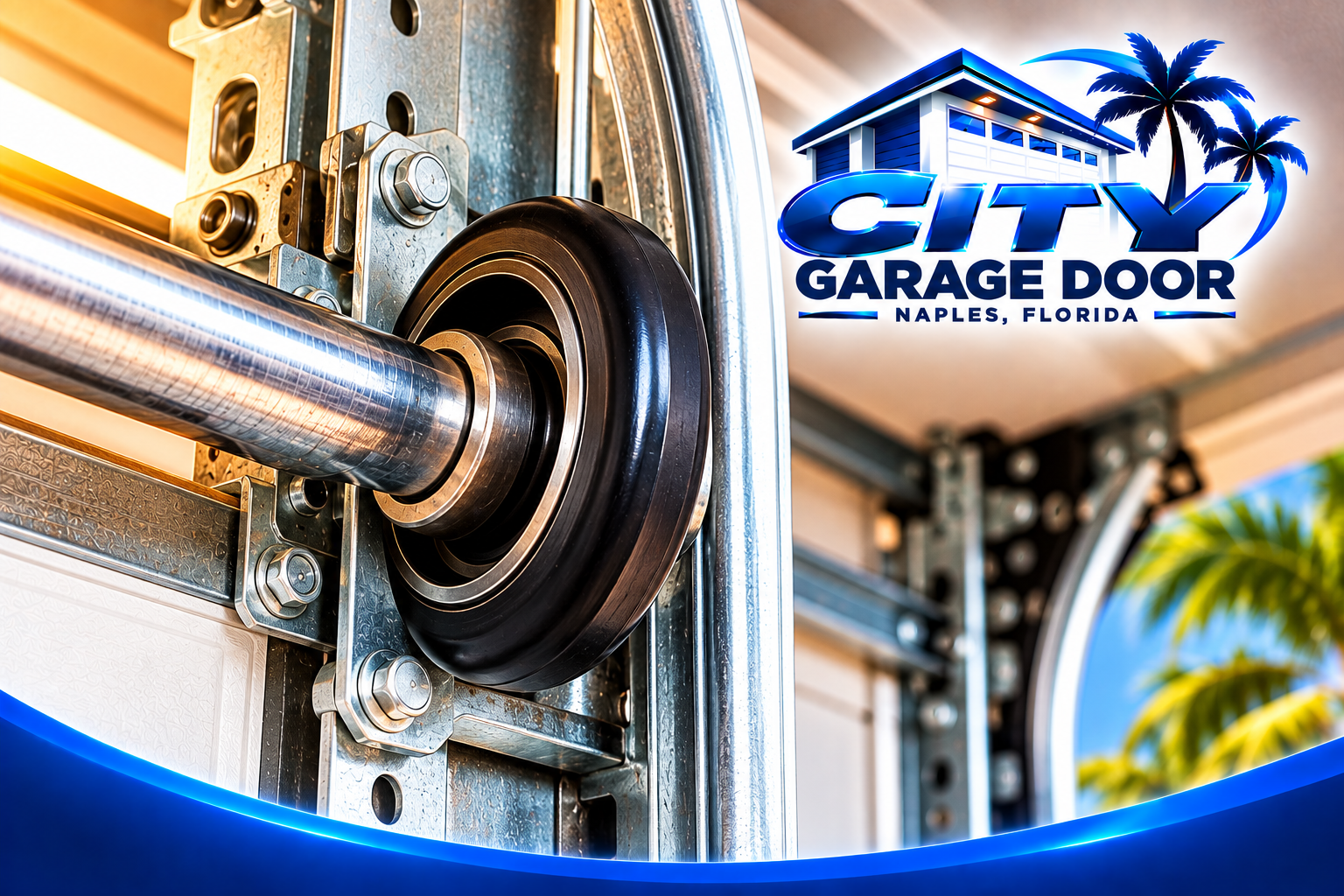
Ten small wheels carry the whole door. Each one rides in a steel channel on a stem set into a hinge, and each one takes its share of 130 to 400 pounds every time the door moves. They are the cheapest part of the assembly and the part under the most continuous mechanical wear, which is why they are almost always the first thing to fail on a door that has never had anything done to it.
Builders fit plastic rollers because they cost pennies. They work for five years or so. Then the nylon chips, the wheel stops turning and starts skidding along the track, and the door begins to shudder. Most people in Golden Gate assume the noise is the opener and start pricing openers. It is almost never the opener.
Which rollers we fit in Golden Gate
- Nylon rollers with steel ball bearings — the standard upgrade and what we fit on most jobs. Quiet, long-lived, ten to fifteen years in this climate. From $119 for the set of ten, fitted.
- Sealed-bearing nylon rollers — the bearing is closed against dust and moisture. Quieter again and the sensible choice where there is a bedroom over the garage. From $159.
- Heavy-duty stems — worth specifying on a heavier insulated door, or where the garage is the main entrance and the door cycles six or eight times a day.
- Steel rollers — what builders fitted on some older Golden Gate doors. They are loud and they wear the track. We replace them rather than match them.
What we check at the same time
Hinges for elongated holes, track for kinks and loose brackets, cables for fraying and the spring for cycle wear. All of it is accessible while the tension is off, so it costs you nothing to find out.
What we will not do
We will not spray the track with grease and call it a service. Lubricant on the track collects grit and makes it worse. Rollers get bearing lubricant, hinges get oil, the track gets wiped clean.
Why rollers wear out early in Golden Gate
Inland in Golden Gate the enemy is not salt, it is heat, humidity and cycles. A garage in Collier runs above 100 degrees inside for months, which cooks the grease out of nylon rollers and hardens the plastic gears in an opener head. Humidity does the rest: the steel shaft sweats, the bearings go dry, and the spring loses a little of its temper every season. Doors here rarely fail dramatically out of nowhere — they get noisier and slower for a year first, and the people who call at the noisy stage pay a fraction of what the people who wait pay.
Golden Gate doors are usually the original builder units on their second or third set of springs. The openings are small, the headroom is tight, and a lot of them were fitted with the lightest spring the builder could get away with, so a single break takes the door off the floor completely.
The housing here runs to mostly 1970s to 1990s concrete block, with a steady run of additions and garage conversions since, which means one-car and two-car doors on modest block homes, plenty of 8×7 and 9×7 openings, and a high proportion of rentals where the door has been patched rather than replaced. That matters when someone quotes you a price over the phone without asking a single question about the door. In Golden Gate City, the Sunshine Boulevard grid, Coronado Parkway and the streets off Santa Barbara we have worked on enough of these openings to know what is behind the drywall before we arrive, which is why we can usually give you a firm number on the phone and stick to it.
Roller replacement prices in Golden Gate
Fitted, with the door re-balanced and the opener re-set. No call-out fee and nothing added for evenings or weekends.
| Job | Starting from |
|---|---|
| Ten nylon rollers, fitted and balanced | $119 |
| Sealed-bearing nylon rollers, set of ten | $159 |
| Hinges replaced with the rollers | $59 |
| Bottom brackets replaced | $79 |
| Bent track section straightened or replaced | $89 |
| Full tune-up: rollers, hinges, balance and safety test | $189 |
If the door has already jumped the track, see off track repair in Golden Gate. If it is heavy by hand as well as noisy, the springs are the real problem — see broken spring replacement in Golden Gate. Full pricing is on the pricing page.
Garage Door Roller Replacement in Golden Gate, FL — common questions
How do I know my rollers are worn?
Listen and look. A worn roller grinds, squeals or makes a flat clacking sound as it passes the curve in the track. Look at the wheels with the door down: chipped or flattened nylon, a wheel that will not spin freely by hand, or a stem with visible play in the hinge all mean the set is done. Rust bleeding out of the roller stems is the other tell.
How much is garage door roller replacement in Golden Gate?
From $119 for a set of ten nylon rollers, fitted, with the door re-balanced and the opener limits re-set. Sealed-bearing rollers, which are quieter again and last longer, start from $159. No call-out fee either way.
How long do garage door rollers last in Golden Gate?
Builder-grade plastic rollers usually give five to seven years here. Nylon rollers with steel ball bearings run ten to fifteen. A Collier garage sits above 100 degrees for months, which cooks the grease out of the bearing and hardens the nylon, so rollers here reach the end of their life earlier than the manufacturer assumed.
Will new rollers make the door quieter?
Noticeably, yes. Most of the noise a garage door makes is the rollers, not the opener. A set of nylon rollers on a door that has been running on cracked plastic ones is the single biggest difference you can make for the money — people are usually surprised how much of the racket disappears.
Can I replace them myself?
The middle rollers, in principle. The bottom two, no — those sit in the bottom brackets, which are under full spring tension even with the door closed, and unbolting one without releasing the springs first is how people get badly hurt. Since we release the tension anyway to do the job properly, it is not a job worth splitting.
Do you replace the hinges too?
We check every hinge while the door is apart and tell you what we find. Hinges with elongated holes let the roller sit at an angle, which is what wears the next set out early. Replacing them alongside the rollers starts from $59 for the set and it is usually worth doing on a door over ten years old.
How long does the job take?
Under an hour for a standard double door. Clamp the door, release the tension, swap the ten rollers, check the hinges and track, re-tension, re-balance by hand, and re-learn the opener limits.
Is this worth doing before something breaks?
It is the one preventive job we actively recommend. A roller that collapses in the curve of the track is a common way a door in Golden Gate jumps the track — which is a $139 call-out plus whatever panel got creased. $119 of rollers on a noisy ten-year-old door is cheap insurance.
Tell Us What the Door Is Doing
You get the price before anyone drives out, and if you decide not to go ahead you owe us nothing.