Commercial · Collier & south Lee
Commercial Garage Door Repair in Naples, FL
Rolling steel, sectional, high-cycle and fire doors. When a bay is down your business is down, so we treat it that way.
The number that matters. A residential door does around 1,500 cycles a year. A busy commercial bay can do that in six weeks. That is why residential-grade springs and rollers fail so fast on commercial doors, and why fitting them is the most common mistake we are called in to undo.
Commercial garage door repair in Naples is a different specification, not just a bigger door
We service commercial doors across Collier County and into south Lee — warehouses off Airport-Pulling and Radio Road, contractor yards in the Industrial Park, restaurants and retail on Tamiami Trail, self-storage, marinas, auto shops, fire stations and HOA maintenance buildings.
The engineering difference is cycle life. Springs are rated in cycles, not years. Standard residential torsion springs are 10,000 cycles. A commercial bay opening forty times a day reaches that inside a year. We quote 25,000, 50,000 or 100,000-cycle springs depending on what the door actually does, because the labour to change them costs more than the springs.
Door types we work on
Rolling steel service doors — the curtain-and-barrel doors on warehouses, storage and loading bays. Common failures are the counterbalance spring inside the barrel, slat damage at the bottom, worn guides and bent bottom bars.
Commercial sectional doors — insulated or non-insulated steel sections on heavier track, usually 24 or 20 gauge, with commercial hinges and 3-inch track on high-lift or vertical-lift configurations.
High-lift and vertical-lift conversions — where you need the ceiling space under the door. Different drums, different cable lengths, different spring calculation. Not something to improvise.
Fire doors — rolling steel doors with a fusible link and a controlled descent. These carry legal obligations, covered below.
Commercial operators — jackshaft, trolley and hoist units, three-phase and single-phase, with the control-station and safety-device requirements that come with them.
Fire doors and the annual drop test
This is the one most Naples businesses do not know about until an inspector raises it. Under NFPA 80, fire door assemblies must be inspected and drop-tested annually, and the test has to be documented and kept on file. The door is released, allowed to descend under its own control, and then reset and re-armed.
If your building has a rolling steel door with a fusible link above it, that is a fire door and the obligation applies. We perform the test, reset the assembly, and give you the written record for your file and your insurer. It is inexpensive, and it is the kind of thing that costs real money when it is missing at the wrong moment.
Safety devices and UL 325
Commercial operators fall under UL 325, and the requirements differ from residential. A commercial door is classified by its control type, and doors operating in anything other than constant-pressure mode need a monitored entrapment protection device — photo eyes or an edge sensor that the operator actively monitors. If a previous contractor bypassed a failed sensor to keep a bay running, that is a liability sitting in your building. We would rather fix the sensor.
Get the bay back open today
Tell us the door type, the width, and what it is doing. Commercial calls get priority and we carry commercial parts.
Commercial work we do most in Collier County
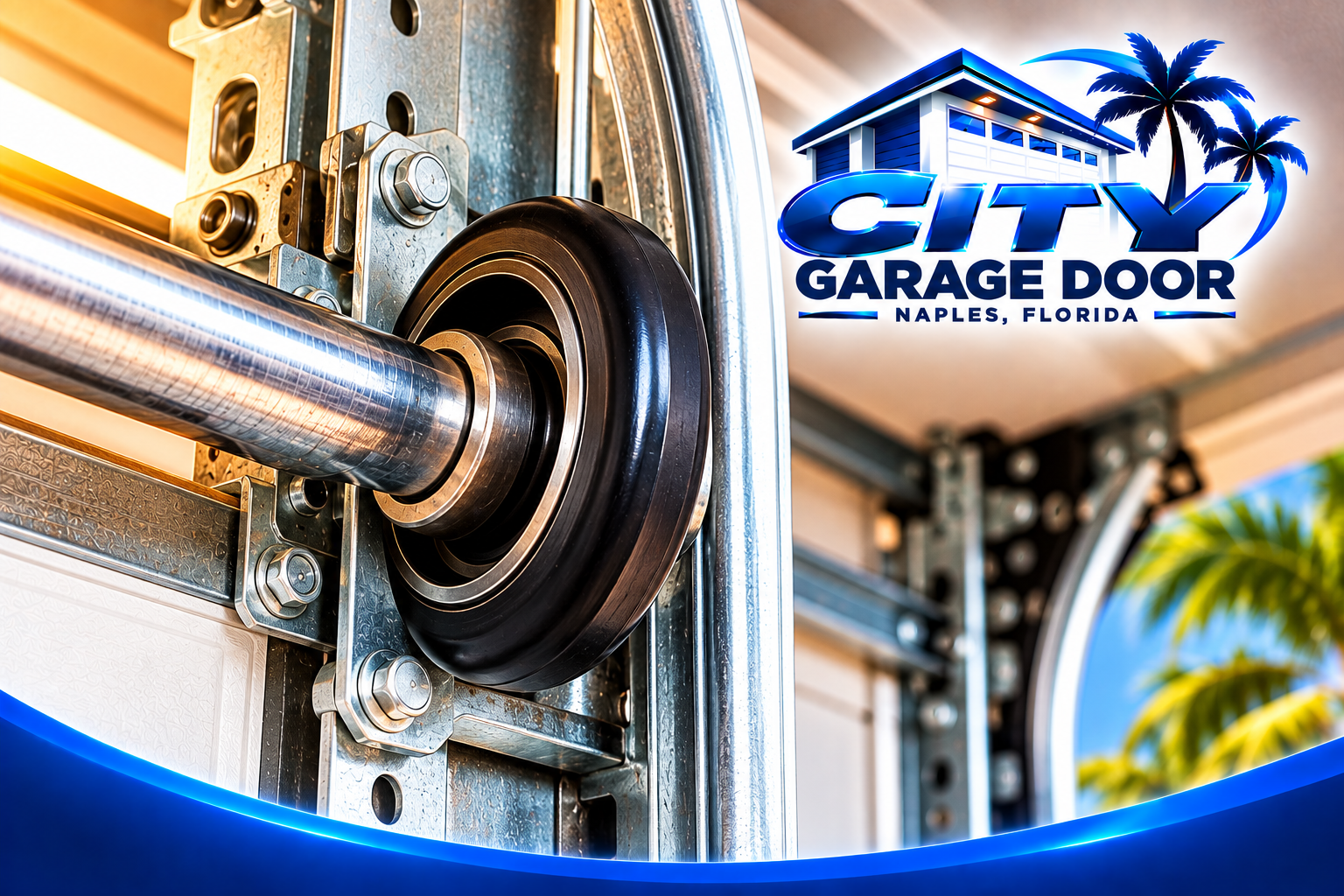
- Barrel spring failure on rolling steel. The door will not stay up, drifts down, or takes two people to lift. Re-tensioning or a full spring replacement inside the barrel.
- Bent bottom bars and damaged slats. Forklift contact. Individual slats can often be replaced without recurtaining the whole door.
- Worn guides and misaligned track. A curtain that binds or walks in the guides will destroy itself if it keeps running.
- Commercial sectional springs and cables. Usually a high-cycle upgrade rather than like-for-like — see spring repair and cable repair.
- Operator faults and bypassed safety devices. Very common and worth correcting properly.
- Fire door drop testing and reset. Annual, documented, per NFPA 80.
- Storm preparation and post-storm repair. Commercial openings are the weak point of most light-frame buildings in Collier.
Commercial pricing guide
| Work | Starting from |
|---|---|
| Call-out, emergency, night, weekend or holiday | No extra charge |
| Rolling steel spring re-tension | From $309 |
| Rolling steel barrel spring replacement | From $749 |
| Commercial sectional torsion springs (high-cycle) | From $399 |
| Commercial cables and drums | From $269 |
| Slat replacement, per slat | From $79 |
| Commercial operator supplied and fitted | From $749 |
| Monitored photo eyes / safety edge fitted | From $249 |
| NFPA 80 fire door drop test and reset, documented | From $219 |
| Planned maintenance visit, per door | From $140 |
Residential prices are on the pricing page. Commercial is quoted per door because size, cycle count and access change the number more than anything else does.
Why downtime is the real cost
A spring on a warehouse bay is a few hundred dollars. A bay that is down through a delivery window is a different number entirely, and a rolling steel door stuck open overnight is an insurance conversation. That is the whole argument for high-cycle springs, planned maintenance and fixing safety devices rather than bypassing them — none of it is expensive next to the thing it prevents.
Areas we cover for commercial work
Multi-bay site? Ask about planned maintenance
One scheduled visit a year costs a fraction of one emergency call-out, and it catches the springs before they take the cables with them.
Frequently asked questions
How fast can you get to a commercial door in Naples?
Commercial calls are prioritised and we run a 24-hour line. For a bay that is blocking deliveries or leaving a building unsecured we aim to be there the same day, and overnight where it cannot wait.
How much does commercial garage door repair cost?
Rolling steel spring re-tensioning typically runs from $309 a barrel spring replacement from $749 depending on size, commercial sectional springs from $399 and a commercial operator from $749 fitted. We quote per door after we know the size, type and cycle count.
What are high-cycle springs and do I need them?
Springs are rated in cycles rather than years. Residential springs are 10,000 cycles; commercial options run 25,000, 50,000 and 100,000. A bay opening forty times a day exhausts a residential spring inside a year, so on commercial work high-cycle almost always costs less over the life of the door.
Does my fire door need an annual inspection?
If it is a rolling steel door with a fusible link, yes. NFPA 80 requires fire door assemblies to be inspected and drop-tested annually with the results documented. We perform the test, reset the assembly and give you the written record.
Can you service three-phase commercial operators?
Yes — jackshaft, trolley and hoist operators in single and three-phase, including control stations, interlocks and monitored entrapment protection devices under UL 325.
Do you offer maintenance contracts?
Yes. For multi-bay sites we schedule planned visits — spring condition, cable and drum inspection, track alignment, roller and hinge replacement, operator service, safety device testing and fire door drop testing where applicable. Planned visits cost a fraction of emergency call-outs.
Do you work with property managers and HOAs?
Regularly. We can quote per door across a portfolio, invoice centrally, and coordinate access with on-site management.
Still not sure? Send us a photo and we will tell you straight.
Tell Us What the Door Is Doing
You get the price before anyone drives out, and if you decide not to go ahead you owe us nothing.